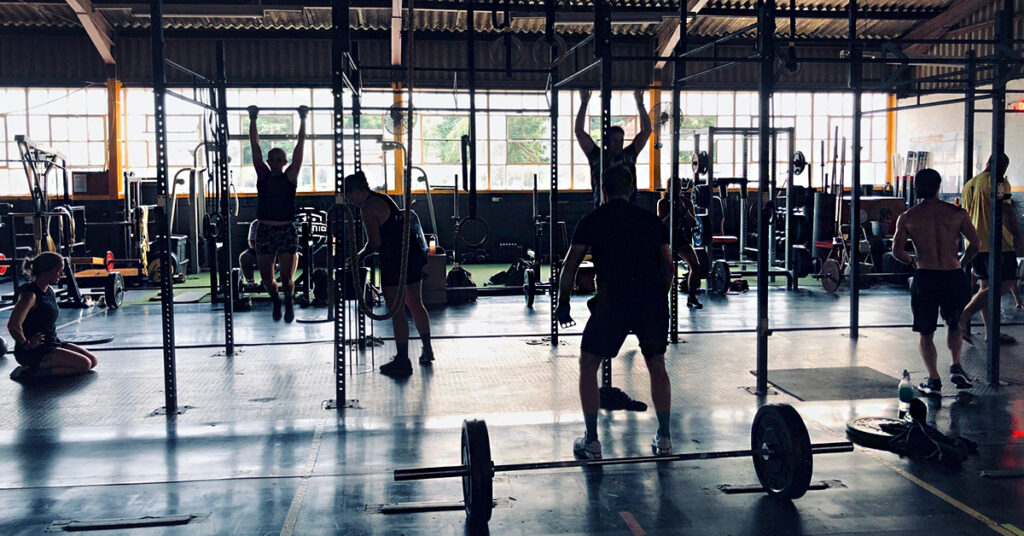
CrossFit and Injuries. One cannot have a conversation about one without the other being brought up. Whether conversing with people in the pro or anti-CrossFit camps.
CrossFit Injures People
When people tell me that CrossFit injures people, I cringe, laugh, cry, and rage all at the same time. The statement is indicative of an argument that is poorly researched and fueled by a portion of the fitness media universe that feels threatened by the worldwide CrossFit movement.
Let’s refine this question: Can you get hurt doing CrossFit? Absolutely. Just as people can get hurt starting out with marathon running, touch rugby, surfing, cycling, or MMA. In short, you can get hurt engaging in any physical activity.
It’s even more likely that you’ll get hurt if you start from a base of being sedentary for the majority of your life, spending 12 hours a day sitting on a couch or office chair, fueled by fast food, Netflix, and shakes. To think you can embark on any exercise program after a life of inactivity and come away unscathed is foolhardy. You’re likely to experience pain, discomfort, and injury above and beyond what’s associated with basic physical exertion.
This is a consequence of “playing sport”.
I’m not sure where we lost sight of this as a species. No caveman went on a hunt for food and came back completely injury-free. Scars, injuries, and ouchies are all part of the price you pay for being human.
To expand on this question, we should be asking: Do we excuse poor coaching practices when someone injures themselves? The answer to that is no.
Leave Your Ego At The Door When You Enter The Gym
Any good coach or gym (of any variety, but we’re focusing on CrossFit) will use ‘scaling’ to manage the abilities of the athlete in relation to the demands of the task.
What is scaling, you ask? Well, it’s the solution to managing your development as an athlete in a CrossFit box, as well as managing your training when you get injured or have a minor injury that limits your training.
Scaling, at its core, is;
The selection and management of a movement in order to match the abilities of the “athlete” with the requirements of the task.
This is my personal understanding and definition, and it guides me as a coach. I use it in the following circumstances:
- When someone has just started CrossFit and is still getting used to the variety and difficulty of the movements and needs their workout managed to achieve the desired outcome safely.
- When someone is injured and needs to either perform an alternative movement altogether or a less taxing movement.
- When someone is trying to achieve the ‘next level’ of a movement and needs to bridge a gap, so to speak. We will find an appropriately scaled movement for them to complete.
The reason ego comes into play is that we often get injured when we are too proud to admit that something is too difficult for us to complete safely. As a new CrossFitter, it’s tempting to get caught up in the energy and intensity of the class and try something that’s too hard for us. This is not only normal but good because if we didn’t push our own boundaries, we wouldn’t find out what we’re capable of.
The challenge arises when we’re faced with something that’s too far outside our ability. In those cases, we need to listen to the advice of the coach on duty and be open to their suggestions and advice. Furthermore, we need to communicate what is causing us discomfort so the best decisions can be made.
The takeaway message is that as athletes and coaches, we need to appreciate the role we each have in managing our expectations and focusing on the quality of movements we execute before worrying about intensity. I can confidently say that the vast majority of CrossFit gyms I’m aware of have this attitude.
I’m Already Injured Though, And I Want To Keep Training, How?
This is maybe more the focus of the blog than all the stuff I just spewed above. Sorry for getting carried away. 😉
Step 1: Seek medical opinion (preferably from someone who does CrossFit).
If you and your coaches don’t know exactly what the nature and extent of your troubles are, managing your movement and recovery becomes much more difficult. Knowledge is power. The better understanding all parties have about the injury’s limitations, the less likely you are to remain injured.
Step 2: Accept responsibility in this process.
You are injured, not your coach, classmates, or friends. You need to do what it takes to get better. It’s nobody else’s responsibility but yours.
Step 3: Follow those instructions.
While this sounds simple, it is really important. If your physiotherapist says, “Please don’t do overhead work for two weeks” because you’ve hurt your shoulder, don’t do overhead work for two weeks, even if you feel better before then. They are professionals, and it is their job.
Step 4: Keep all parties informed.
The more your physiotherapist knows about what happened, the better they can help. The more accurately you provide feedback about your recovery, the better they can advance your treatment. And the same goes for informing your coach; they need to know what’s going on. They can’t assume you’re healed when, in fact, you’ve only been cleared to do rehab movements.
Step 5: Follow the scaling advice of your coaches.
I don’t care if you used to deadlift 300kg. If you’ve hurt your back and there are deadlifts in the WOD, you’ll need to do something else. Don’t argue, just follow the advice, and the process will lead you back to full health. In fact, you’ll probably come back stronger and fitter than before! The concept of scaling and adapting movements is a key element of CrossFit workouts specifically designed to keep people moving safely. Use it!
Heal Your Mindset First
The most revolutionary approach we can take to managing our perception of CrossFit and its relationship with injuries and training comes about when we begin to realize that CrossFit is not something that has a lifespan.
You will never get “too old” to CrossFit. You are never “too weak” to CrossFit. You are never “too busy” to CrossFit.
The more you see CrossFit as part of your life for the rest of your life, the more you will appreciate its true value. This lifestyle change need not be rushed or require shortcuts. The value is truly in the foundation that it is FOR EVERYONE, and to paraphrase Greg Glassman, the needs of an Olympic athlete and your grandmother differ by degree, NOT kind.
Injuries and setbacks will happen, but they need not stop you in your tracks if you approach them correctly.
Go play Fitness now!